Curriculum
- 24 Sections
- 77 Lessons
- 411 Hours
Expand all sectionsCollapse all sections
- mensuration 3d38 ItemsMensuration 3D is the branch of mathematics that deals with measuring three-dimensional solids like cubes, cylinders, cones, and spheres. It focuses mainly on finding volume (space occupied) and surface area (outer covering) of these objects. It is widely used in real life for construction, storage, and solving competitive exam problems.
- 1.1Cube
- 1.2Cube level 110 Minutes10 Questions
- 1.3cube level 210 Minutes10 Questions
- 1.4cube level 310 Minutes10 Questions
- 1.5Cuboid
- 1.6Cuboid level 110 Minutes10 Questions
- 1.7cuboid level 210 Minutes10 Questions
- 1.8cuboid level 310 Minutes10 Questions
- 1.9Hemisphere
- 1.10hemisphere level 110 Questions
- 1.11hemisphere level 210 Questions
- 1.12hemisphere level 310 Minutes10 Questions
- 1.13Prisms
- 1.14prism level 110 Minutes10 Questions
- 1.15prism level 210 Minutes10 Questions
- 1.16prism level 310 Minutes10 Questions
- 1.17Pyramids
- 1.18pyramid level 110 Minutes10 Questions
- 1.19pyramid level 210 Minutes10 Questions
- 1.20pyramid level 310 Minutes10 Questions
- 1.21Tetrahedron
- 1.22teterahederon level 110 Minutes10 Questions
- 1.23teterahederon level 210 Minutes10 Questions
- 1.24teterahederon level 310 Minutes10 Questions
- 1.25Sphere
- 1.26Sphere level 110 Minutes10 Questions
- 1.27Sphere level 210 Minutes10 Questions
- 1.28Sphere level 310 Minutes10 Questions
- 1.29Cone
- 1.30Cone level 110 Minutes10 Questions
- 1.31Cone level 310 Minutes10 Questions
- 1.32Cone level 210 Minutes10 Questions
- 1.33Cylinder
- 1.34Cylinder level 110 Minutes10 Questions
- 1.35Cylinder level 29 Minutes10 Questions
- 1.36Cylinder level 310 Minutes10 Questions
- 1.37Previous year questions
- 1.38questions to practice
- mensuration 2d39 ItemsMensuration is a branch of Mathematics that deals with the measurement of geometric figures. When we talk about 2D mensuration, we focus on flat shapes (also called plane figures) that have only length and breadth, but no height or depth.🔹 What is 2D Mensuration? 2D mensuration involves calculating: Area → the space inside a shape Perimeter → the boundary or total length around a shape These concepts are based on Geometry.
- 2.1introduction
- 2.2square
- 2.3square level 110 Minutes10 Questions
- 2.4square level 210 Minutes10 Questions
- 2.5square level 310 Minutes10 Questions
- 2.6Rectangle
- 2.7Rectangle level 110 Minutes10 Questions
- 2.8Rectangle level 210 Minutes10 Questions
- 2.9Rectangle level 310 Minutes10 Questions
- 2.10Parallelogram
- 2.11Parallelogram level 110 Minutes10 Questions
- 2.12Parallelogram level 210 Minutes10 Questions
- 2.13Parallelogram level 310 Minutes10 Questions
- 2.14Trapezium
- 2.15Trapezium level 110 Minutes10 Questions
- 2.16Trapezium level 210 Minutes10 Questions
- 2.17Trapezium level 310 Minutes10 Questions
- 2.18Rhombus
- 2.19Rhombus level 110 Minutes10 Questions
- 2.20Rhombus level 210 Minutes10 Questions
- 2.21Rhombus level 310 Minutes10 Questions
- 2.22Triangle
- 2.23Triangle level 110 Minutes10 Questions
- 2.24Triangle level 210 Minutes10 Questions
- 2.25Triangle level 310 Minutes10 Questions
- 2.26equilateral triangle10 Minutes10 Questions
- 2.27isosceles triangle10 Minutes10 Questions
- 2.28Circle
- 2.29Circle level 110 Minutes10 Questions
- 2.30Circle level 210 Minutes10 Questions
- 2.31Circle level 310 Minutes10 Questions
- 2.32Sector of circle10 Minutes10 Questions
- 2.33polygon
- 2.34Hexagon
- 2.35hexagon10 Minutes10 Questions
- 2.36Semi circle10 Minutes10 Questions
- 2.37Previous year questions 117 Minutes17 Questions
- 2.38Previous year questions 217 Minutes17 Questions
- 2.39Previous year questions 317 Minutes17 Questions
- Time and Work11 ItemsThis topic deals with efficiency and work completion. It explains how individuals or groups complete tasks over time. Includes concepts like work rates, pipes and cisterns, and alternate work. Logical thinking is key to solving these problems.
- 3.1time and work 115 Minutes15 Questions
- 3.2time and work 215 Minutes15 Questions
- 3.3time and work 315 Minutes15 Questions
- 3.4time and work 415 Minutes15 Questions
- 3.5time and work 515 Minutes15 Questions
- 3.6time and work 615 Minutes15 Questions
- 3.7time and work 715 Minutes15 Questions
- 3.8time and work 84 Questions
- 3.9Previous year question 115 Minutes15 Questions
- 3.10Previous year question 215 Minutes14 Questions
- 3.11pyq with solution
- Pipe and cistern5 ItemsPipes and Cisterns is a mathematical concept used to calculate the time required to fill or empty a tank based on the flow rates of various pipes. It is a direct extension of Time and Work theory, where the "work" to be done is filling the total capacity of a reservoir.
- Number System87 ItemsBuild a strong foundation in Number System by mastering core concepts like divisibility, remainders, surds, and indices. Learn shortcut techniques and solve CAT-level questions with speed and accuracy.
- 5.1Classification of Numbers 1🎥
- 5.2Classification of Numbers 2🎥
- 5.3Classification of Numbers 3🎥
- 5.4Classification of Numbers questions part 1🎥
- 5.5Classification of Numbers questions part 2🎥
- 5.6Classification of numbers quiz 0115 Minutes15 Questions
- 5.7Classification of numbers quiz 0215 Minutes15 Questions
- 5.8Classification of numbers quiz 035 Questions
- 5.9divisibility part 1 concept🎥
- 5.10divisibility part 2 concept🎥
- 5.11divisibility part 3 concept🎥
- 5.12divisibility part 4 concept🎥
- 5.13divisibility questions level 1 part 1 🎥
- 5.14divisibility questions level 1 part 2 🎥
- 5.15divisibility questions level 2 part 1 🎥
- 5.16divisibility questions level 2 part 2 🎥
- 5.17divisibility quiz 0115 Minutes15 Questions
- 5.18divisibility quiz 0215 Minutes15 Questions
- 5.19divisibility quiz 0315 Minutes19 Questions
- 5.20unit digit concept and questions level 1 🎥
- 5.21unit digit concept and questions level 2 🎥
- 5.22unit digit concept and questions level 3 🎥
- 5.23unit digit concept Quiz 0115 Minutes15 Questions
- 5.24unit digit concept Quiz 0215 Minutes15 Questions
- 5.25unit digit concept Quiz 0315 Minutes6 Questions
- 5.26last two digits concept and questions part 1🎥
- 5.27last two digits concept and questions part 2
- 5.28remainder concept and question part 1
- 5.29remainder concept and question part 2🎥
- 5.30remainder concept and question part 3🎥
- 5.31remainder concept and question part 4🎥
- 5.32remainder concept and questions part 5🎥
- 5.33remainder concept and questions part 6🎥
- 5.34remainder concept and questions part 7🎥
- 5.35Remainder Concept Quiz 0115 Minutes15 Questions
- 5.36Remainder Concept Quiz 0215 Minutes15 Questions
- 5.37Remainder Concept Quiz 0315 Minutes15 Questions
- 5.38Remainder Concept Quiz 0415 Minutes15 Questions
- 5.39simplification part 1surds and indices concept and questions part 1🎥
- 5.40simplification part 1surds and indices concept and questions part 2🎥
- 5.41simplification part 1surds and indices concept and questions part 3🎥
- 5.42simplification part 1 surds and indices concept and questions part 4🎥
- 5.43simplification part 2🎥
- 5.44simplification part 3🎥
- 5.45simplification surds and indices quiz 0115 Minutes15 Questions
- 5.46simplification surds and indices quiz 0215 Minutes15 Questions
- 5.47simplification surds and indices quiz 0315 Minutes15 Questions
- 5.48simplification surds and indices quiz 0415 Minutes7 Questions
- 5.49simplification 0115 Minutes15 Questions
- 5.50simplification 0215 Minutes15 Questions
- 5.51simplification 0315 Minutes13 Questions
- 5.52vodmas 🎥
- 5.53vodmas13 Questions
- 5.54series 🎥
- 5.55Series10 Minutes10 Questions
- 5.56power roots exponents
- 5.57ladder🎥
- 5.58ladder quiz15 Minutes18 Questions
- 5.59indices 🎥
- 5.60fraction comparison 🎥
- 5.61fraction comparison2 Questions
- 5.62calculation based🎥
- 5.63calculation based quiz15 Minutes18 Questions
- 5.64abc type🎥
- 5.65abc type quiz15 Minutes5 Questions
- 5.66number of zero part 1🎥
- 5.67number of zero part 2🎥
- 5.68number of zero part 3🎥
- 5.69factorial concept and questions 🎥
- 5.70factorial advanced concept and questions part 1 🎥
- 5.71factorial advanced concept and questions part 2 🎥
- 5.72factorial advanced concept and questions part 3 🎥
- 5.73cat advanced concepts part 1🎥
- 5.74cat previous years questions🎥
- 5.75cat advanced concepts part 2🎥
- 5.76cat advanced concepts part 3🎥
- 5.77cat advanced concepts part 4🎥
- 5.78cat previous years questions quiz 0115 Minutes10 Questions
- 5.79cat previous years questions quiz 0210 Minutes10 Questions
- 5.80cat previous years questions quiz 0310 Minutes10 Questions
- 5.81cat previous years questions quiz 0410 Minutes10 Questions
- 5.82cat previous years questions quiz 0510 Minutes10 Questions
- 5.83cat previous years questions quiz 0610 Minutes10 Questions
- 5.84cat previous years questions quiz 0710 Minutes10 Questions
- 5.85cat previous years questions quiz 0810 Minutes10 Questions
- 5.86cat previous years questions quiz 0910 Minutes10 Questions
- 5.87cat previous years questions quiz 1010 Minutes3 Questions
- trignometry3 Items
- Averages3 ItemsAverages represent a central value of a group of numbers. This topic includes simple averages, weighted averages, and changes in average. It is widely used in real-life situations like marks, income, and statistics. It also helps in simplifying complex calculations.
- Alligations2 ItemsAlligation is a shortcut method used to solve mixture problems. It helps in finding ratios when two or more quantities are mixed. This topic is commonly used in problems involving price, concentration, and percentages. It saves time compared to traditional methods.
- Ratio, Proportion & Variation3 ItemsThis topic explains how quantities are related and compared. Ratio compares two quantities, while proportion shows equality of ratios. It also includes direct and inverse variation. These concepts are widely used in real-life scenarios like sharing, scaling, and mixtures.
- Percentages3 ItemsPercentages express values as parts of 100. This topic is the foundation for many other chapters like profit & loss, interest, and data interpretation. It includes increase/decrease, successive percentages, and conversions. Strong understanding helps in solving many exam questions quickly.
- Profit, Loss and Discount12 ItemsThis chapter focuses on motion and travel problems. It includes speed, distance, and time relationships. Topics like trains, boats and streams, and relative speed are covered. It is widely used in real-life scenarios and exams.
- 11.1quiz 115 Minutes15 Questions
- 11.2quiz 215 Minutes15 Questions
- 11.3quiz 315 Minutes15 Questions
- 11.4quiz 415 Minutes15 Questions
- 11.5quiz 515 Minutes15 Questions
- 11.6quiz 615 Minutes9 Questions
- 11.7previous year question quiz 116 Minutes16 Questions
- 11.8previous year questions quiz 216 Minutes16 Questions
- 11.9trial1 Question
- 11.10discount quiz 0115 Minutes15 Questions
- 11.11discount quiz 0215 Minutes15 Questions
- 11.12discount quiz 0320 Minutes20 Questions
- Time, Speed and Distance21 ItemsThis chapter deals with buying and selling concepts. It includes cost price, selling price, marked price, profit, loss, and discounts. Questions often involve multiple transactions and percentage changes. It is one of the most important topics in competitive exams.
- 12.1cat previous years questions quiz 0115 Minutes11 Questions
- 12.2cat previous years questions quiz 0211 Questions
- 12.3cat previous years questions quiz 0315 Minutes11 Questions
- 12.4cat previous years questions quiz 0415 Minutes11 Questions
- 12.5cat previous years questions quiz 0515 Minutes10 Questions
- 12.6Time, Speed and Distance quiz 0115 Minutes15 Questions
- 12.7Time, Speed and Distance quiz 0215 Minutes15 Questions
- 12.8Time, Speed and Distance quiz 0315 Minutes15 Questions
- 12.9Time, Speed and Distance quiz 0415 Minutes15 Questions
- 12.10Time, Speed and Distance quiz 0515 Minutes15 Questions
- 12.11Time, Speed and Distance quiz 0615 Minutes15 Questions
- 12.12Time, Speed and Distance quiz 0715 Minutes15 Questions
- 12.13Time, Speed and Distance quiz 0815 Minutes15 Questions
- 12.14Trains quiz 0115 Minutes15 Questions
- 12.15Trains quiz 0215 Minutes15 Questions
- 12.16Trains quiz 0320 Minutes20 Questions
- 12.17circular motion quiz 0121 Questions
- 12.18Race Problems quiz 0115 Minutes15 Questions
- 12.19Race Problems quiz 0220 Minutes19 Questions
- 12.20boat and stream quiz 0115 Minutes15 Questions
- 12.21boat and stream quiz 0215 Minutes9 Questions
- CI/SI Instalments13 ItemsThis topic focuses on financial mathematics. It includes Simple Interest (SI), Compound Interest (CI), and installment-based problems. It explains how money grows over time with interest. It is useful in banking, loans, and investment-related questions.
- 13.1cat previous years questions quiz 0110 Questions
- 13.2cat previous years questions quiz 028 Questions
- 13.3simple interest quiz 0115 Minutes15 Questions
- 13.4simple interest quiz 0215 Minutes15 Questions
- 13.5simple interest quiz 0315 Minutes15 Questions
- 13.6simple interest quiz 0415 Minutes14 Questions
- 13.7compound interest quiz 01(old)15 Minutes10 Questions
- 13.8compound interest quiz 02(old)15 Minutes10 Questions
- 13.9compound interest quiz 0115 Minutes15 Questions
- 13.10compound interest quiz 0215 Questions
- 13.11compound interest quiz 0315 Minutes15 Questions
- 13.12compound interest quiz 0415 Minutes15 Questions
- 13.13compound interest quiz 0515 Minutes15 Questions
- Geometry28 ItemsGeometry deals with shapes, angles, lines, and their properties. It includes triangles, circles, polygons, and theorems. Visualization plays an important role in solving problems. It is a conceptual and scoring topic.
- 14.1Triangle quiz 115 Minutes15 Questions
- 14.2Triangle quiz 215 Minutes15 Questions
- 14.3Triangle quiz 312 Questions
- 14.4Types of triangles quiz 115 Minutes10 Questions
- 14.5Types of triangles quiz 215 Minutes14 Questions
- 14.6Types of triangles quiz 3 (21 Questions)15 Minutes21 Questions
- 14.7Centres of Triangle quiz 115 Minutes15 Questions
- 14.8Centres of Triangle quiz 215 Minutes14 Questions
- 14.9Centres of Triangle quiz 315 Minutes15 Questions
- 14.10Centres of Triangle quiz 4 (12 Questions)12 Minutes11 Questions
- 14.11Similarity and Congruence quiz 115 Minutes15 Questions
- 14.12Similarity and Congruence quiz 2 (17 Questions)17 Minutes17 Questions
- 14.13Quardilateral quiz 115 Minutes15 Questions
- 14.14Quardilateral quiz 215 Minutes15 Questions
- 14.15Quardilateral quiz 3 (13 questions)15 Minutes13 Questions
- 14.16polygon 0115 Minutes15 Questions
- 14.17polygon 02 (7 questions)15 Minutes7 Questions
- 14.18circle 0115 Minutes12 Questions
- 14.19circle 0215 Minutes14 Questions
- 14.20circle 0315 Minutes15 Questions
- 14.21circle 0418 Questions
- 14.22previous year questions quiz 115 Minutes15 Questions
- 14.23previous year questions quiz 215 Minutes15 Questions
- 14.24previous year questions quiz 3 (9 questions)15 Minutes9 Questions
- 14.25pyq (12 questions)15 Minutes12 Questions
- 14.26pyq (25 questions)25 Questions
- 14.27pyq (33 questions)33 Questions
- 14.28similar pyqs
- Elements of Algebra0 ItemsThis topic introduces algebraic expressions and identities. It includes simplification, factorization, and basic equations. It forms the base for advanced algebra topics. Logical manipulation of expressions is key here.
- Theory of Equations0 ItemsThis chapter focuses on solving equations and understanding roots. It includes quadratic equations and relationships between roots and coefficients. It is useful for solving higher-level algebra problems. Concepts are both theoretical and application-based.
- Set Theory0 ItemsSet theory deals with collections of elements. It includes operations like union, intersection, and complement. Venn diagrams are used to solve problems visually. It is widely used in logical reasoning and probability.
- Logarithm0 ItemsLogarithms simplify calculations involving large numbers and exponents. This topic includes log rules, properties, and equations. It is helpful in algebra and exponential problems. Understanding properties is essential for quick solving.
- Functions and Graph0 ItemsThis topic explains relationships between variables. Functions map inputs to outputs, and graphs help visualize them. It includes linear, quadratic, and other functions. Important for understanding trends and patterns.
- Sequence, Series and Progressions0 ItemsThis chapter deals with ordered numbers and patterns. It includes Arithmetic Progression (AP), Geometric Progression (GP), and Harmonic Progression (HP). It also covers sum of series. Useful in pattern-based questions.
- Permutations & Combinations0 ItemsThis topic focuses on counting arrangements and selections. Permutations deal with order, while combinations do not. It is widely used in probability problems. Logical counting methods are essential here.
- Probability0 ItemsProbability measures the chance of an event occurring. It includes basic rules, conditional probability, and independent events. It is widely used in real-life situations like games and predictions. Concept clarity is very important.
- Coordinate Geometry0 ItemsThis topic uses a coordinate plane to study geometry. It includes distance formula, slope, and equations of lines. It connects algebra and geometry. Visualization and formulas both are important.
- DI5 Items
FAQs
Yes, the course starts from basic concepts and gradually moves to advanced CAT-level questions.
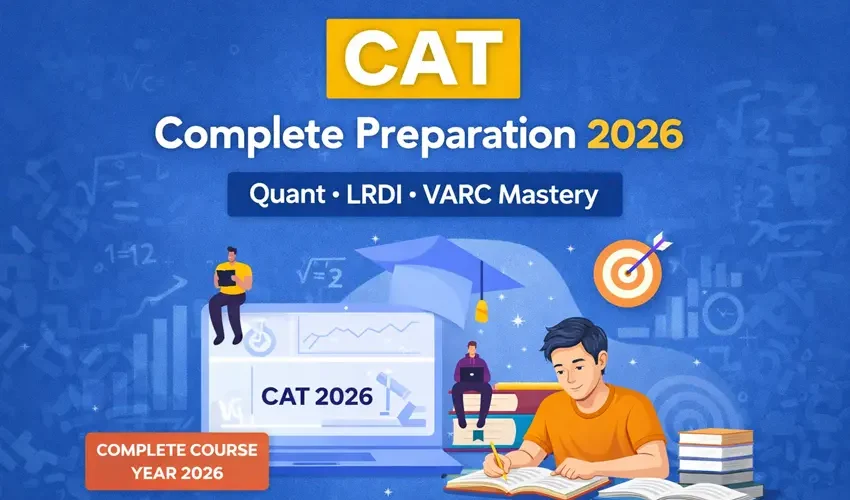
Yes, it includes QA, LRDI, and VARC, along with practice sets and mock tests.
Yes, you will get full-length mocks + topic-wise tests with detailed analysis.
You get lifetime access, so you can study at your own pace.
Yes, it also helps in exams like NMAT, SNAP, XAT, and CMAT.
Ideally, 2–3 hours daily is enough if you follow the course consistently.
Yes, you’ll get doubt-solving support via community or direct channels.
Absolutely. The course is designed for flexible learning, perfect for working professionals.
Instructor

9 Students2 Courses
Reviews