Previous year questions
Q.1 All the vertices of a rectangle lie on a circle of radius \( R \). If the perimeter of the rectangle is \( P \), then the area of the rectangle is:
(a) \( \frac{P^2}{16} – R^2 \)
(b) \( \frac{P^2}{8} – 2R^2 \)
(c) \( \frac{P^2}{2} – 2PR \)
(d) \( \frac{P^2}{8} – \frac{R^2}{2} \)
Q.2 Suppose the medians BD and CE of a \( \triangle ABC \) intersect at a point O. If the area of \( \triangle ABC \) is 108 sq cm, then the area of the \( \triangle EOD \), (in sq cm) is:
(a) \( 12 \)
(b) \( 18 \)
(c) \( 24 \)
(d) \( 36 \)
Q.3 In a \( \triangle ABC \), AB = AC = 8 cm. A circle drawn with BC as diameter passes through A. Another circle drawn with centre at A passes through B and C. Then, the area (in sq cm) of the overlapping region between the two circles is:
(a) \( 16(\pi – 1) \)
(b) \( 32\pi \)
(c) \( 32(\pi – 1) \)
(d) \( 16\pi \)
Q.4 A park is shaped like a rhombus and has area 96 sq m. If 40 m of fencing is needed to enclose the park, the cost (in ₹) of laying electric wires along its two diagonals, at the rate of ₹ 125 per m, is:
(a) \( 2400 \)
(b) \( 3000 \)
(c) \( 3200 \)
(d) \( 3600 \)
Q.5 If a rhombus has area 12 sq cm and side length 5 cm, then the length (in cm) of its longer diagonal is:
(a) \( \frac{\sqrt{37} + \sqrt{13}}{2} \)
(b) \( \sqrt{37} + \sqrt{13} \)
(c) \( \frac{\sqrt{13} + \sqrt{12}}{2} \)
(d) \( \sqrt{13} + \sqrt{12} \)
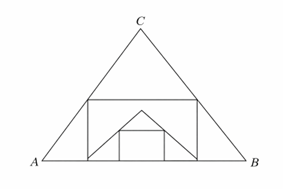
Q.6 In the given figure, ABC is an equilateral triangle inscribing a square of maximum possible area. Again, in this square, there is an equilateral triangle whose side is same as that of the square. Further the smaller equilateral triangle inscribes a square of maximum possible area. What is the area of the innermost square if each side of the outermost triangle be 0.01 m?
(a) \( (873 – 504\sqrt{3}) \) cm²
(b) \( (738 – 504\sqrt{3}) \) cm²
(c) \( (873 – 405\sqrt{2}) \) cm²
(d) None of these
Q.7 Three equal circles of unit radius touch each other. Then, the area of the circle circumscribing the three circles is:
(a) \( 6\pi (2 + \sqrt{3})^2 \)
(b) \( \frac{\pi}{6} (2 + \sqrt{3})^2 \)
(c) \( \frac{\pi}{3} (2 + \sqrt{3})^2 \)
(d) \( 3\pi (2 + \sqrt{3})^2 \)
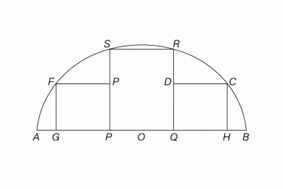
Q.8 In the following figure there is a semicircle with centre \( O \) and diameter AB (= 2r). PQRS is a square of maximum possible area. P and Q lie on the diameter AB and R, S lie on the arc of the semicircle. There are two more squares of maximum possible area EFGP and CDQH. What is the sum of lengths of RC and FS?
(a) \( \sqrt{\frac{2}{5}} (2r) \)
(b) \( \frac{2\sqrt{2}r}{4} \)
(c) \( \frac{\sqrt{2}}{5} r \)
(d) None of these
Q.9 The wheels of bicycles A and B have radii 30 cm and 40 cm, respectively. While travelling a certain distance, each wheel of A required 5000 more revolutions than each wheel of B. If bicycle B travelled this distance in 45 min, then its speed (in km per hour) was:
(a) \( 16\pi \)
(b) \( 12\pi \)
(c) \( 18\pi \)
(d) \( 14\pi \)
Q.10 Consider \( \triangle ABC \) with AB = 8 cm and area 24 sq cm. If AB is greater than the other two sides and the triangle’s centroid, incentre, circumcenter and orthocenter are collinear, find its perimeter.
(a) \( 16 + 4\sqrt{13} \)
(b) \( 8 + 4\sqrt{13} \)
(c) \( 8 + 8\sqrt{13} \)
(d) \( 8 + 6\sqrt{13} \)
Q.11 A box is built vertically upwards from a base that is a regular hexagon of side \( a \). The height of the shape is \( h \). If the height of this shape is doubled, the total surface area increases by 50%, find the ratio \( a : h \).
(a) 2 : 1
(b) \( 2 : \sqrt{3} \)
(c) \( 3 : \sqrt{2} \)
(d) \( \sqrt{2} : 1 \)
Q.12 A regular polygon has an even number of sides. If the product of the length of its sides and the distance between two opposite sides is \(\frac{1}{4}\) of its area, then find the number of sides it has.
(a) 6
(b) 8
(c) 20
(d) 16
Q.13 What is the area, circumradius and inradius of a regular hexagon of side \( a \)?
(a) \( \frac{3\sqrt{3}}{2} a^2, \ a, \ \frac{\sqrt{3}}{2} a \)
(b) \( \frac{3}{2} a^2, \ \frac{a}{2}, \ \frac{\sqrt{3}}{2} a \)
(c) \( a^2, \ \frac{a}{2}, \ 2a \)
(d) \( \frac{\sqrt{3}}{2} a^2, \ a, \ \sqrt{3}a \)
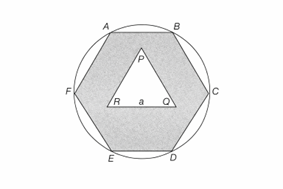
Q.14 ABCDEF is a regular hexagon and PQR is an equilateral triangle of side \( a \). The area of the shaded portion is \( X \) and CD : PQ = 2 : 1. Find the area of the circle circumscribing the hexagon in terms of \( X \).
(a) \( \frac{16\pi}{23\sqrt{3}} X \)
(b) \( \frac{42\pi}{5\sqrt{3}} X \)
(c) \( \frac{2\pi}{3\sqrt{3}} X \)
(d) \( 2\sqrt{3}\pi X \)
Q.15 Consider a square ABCD with mid-points E, F, G, H of AB, BC, CD and DA, respectively. Let L denote the line passing through F and H. Consider points P and Q on L and inside ABCD such that the angles APD and BQC both equal 120°. What is the ratio of the area of ABQCDP to the remaining area inside ABCD?
(a) \( \frac{4\sqrt{2}}{3} \)
(b) \( 2 + \sqrt{3} \)
(c) \( \frac{10 – 3\sqrt{3}}{9} \)
(d) \( 2\sqrt{3} – 1 \)
Q.16 Let \( S_1 \) be a square of side \( a \). Another square \( S_2 \) is formed by joining the mid-points of the sides of \( S_1 \). The same process is applied to \( S_2 \) to form \( S_3 \) and so on. If \( A_1, A_2, A_3, \dots \) are the areas and \( P_1, P_2, P_3, \dots \) are the perimeters, then the ratio \( \frac{P_1 + P_2 + P_3 + \dots}{A_1 + A_2 + A_3 + \dots} \) equals:
(a) \( \frac{2(1 + \sqrt{2})}{a} \)
(b) \( \frac{2(2 – \sqrt{2})}{a} \)
(c) \( \frac{2(2 + \sqrt{2})}{a} \)
(d) \( \frac{2(1 + 2\sqrt{2})}{a} \)
Q.17 Consider two different cloth-cutting processes. In the first one, \( n \) circular cloth pieces are cut from a square cloth of side \( a \). The square is divided into \( n \) smaller squares and a circle of maximum possible area is cut from each. In the second process, only one such circle is cut. The remaining cloth is scrapped in both cases. The ratio of scrap areas (former : latter) is:
(a) 1 : 1
(b) \( \sqrt{2} : 1 \)
(c) \( \frac{n(4 – \pi)}{4n – \pi} \)
(d) \( \frac{4n – \pi}{n(4 – \pi)} \)
Q.18 A piece of paper is in the shape of a right angled triangle and is cut along a line parallel to the hypotenuse, leaving a smaller triangle. There was a 35% reduction in the hypotenuse. If the original area was 34 cm², what is the area of the smaller triangle?
(a) 16.565
(b) 15.465
(c) 16.665
(d) 14.365
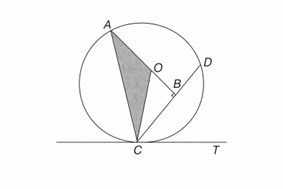
Q.19 In the given diagram, CT is tangent at C, making an angle of 45° with CD. O is the centre of the circle. CD = 10 cm. What is the perimeter of the shaded region (\( \triangle AOC \)) approximately?
(a) 25 cm
(b) 26 cm
(c) 27 cm
(d) 28 cm
Q.20 A rectangle is drawn such that none of its sides has length greater than \( a \). All lengths less than \( a \) are equally likely. The chance that the rectangle has its diagonal greater than \( a \) is (in terms of %):
(a) 29.3%
(b) 21.5%
(c) 66.66%
(d) 33.33%
Q.21 In the figure given, OABC is a parallelogram. The area of the parallelogram is 21 sq units and the point C lies on the line \( x = 3 \). Find the coordinates of B.
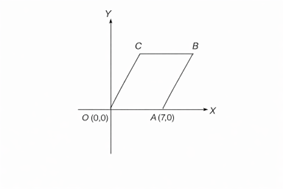
(a) (3, 10)
(b) (10, 3)
(c) (10, 10)
(d) (8, 3)
Q.22 On a plate in the shape of an equilateral \( \triangle ABC \) with area \( 16\sqrt{3} \) sq cm, a rod GD of height 8 cm is fixed vertically at the centre of the triangle. G is a point on the plate. If the areas of \( \triangle AGD \) and \( \triangle BGD \) are both equal to \( 4\sqrt{19} \) sq cm, find the area of \( \triangle CGD \) (in sq cm).
(a) \( 3\sqrt{19} \)
(b) \( 4\sqrt{19} \)
(c) \( 12\sqrt{3} \)
(d) None of these
Q.23 Rekha drew a circle of radius 2 cm on a graph paper of grid 1 cm × 1 cm. She calculated the area by counting only full unit squares inside the circle. If the obtained value was \( d \) sq cm less than the correct value, find the maximum possible value of \( d \).
(a) 6.28
(b) 7.28
(c) 7.56
(d) 8.56
Q.24 In the above question, what is the minimum possible value of \( d \)?
(a) 4.56
(b) 5.56
(c) 6.56
(d) 3.56
Q.25 The circumference of a cylinder is 3 feet and its height is 16 feet. An insect climbs the pole in a spiral such that one complete spiral covers 4 feet in height. When it reaches the top, what is the total distance covered?
(a) 16 feet
(b) 18 feet
(c) 20 feet
(d) 25 feet
Q.26 In a \( \triangle ABC \), the lengths AB and AC are 17.5 cm and 9 cm, respectively. Let D be a point on BC such that AD is perpendicular to BC. If AD = 3 cm, find the radius (in cm) of the circumcircle of \( \triangle ABC \).
(a) 17.0
(b) 27.85
(c) 22.45
(d) 32.25
(e) 26.25
Q.27 Two circles, both of radius 1 cm, intersect such that the circumference of each passes through the centre of the other. What is the area (in sq cm) of the intersecting region?
(a) \( \frac{\pi}{3} – \frac{\sqrt{3}}{4} \)
(b) \( \frac{2\pi}{3} + \frac{\sqrt{3}}{2} \)
(c) \( \frac{4\pi}{3} – \frac{\sqrt{3}}{2} \)
(d) \( \frac{4\pi}{3} + \frac{\sqrt{3}}{2} \)
(e) \( \frac{2\pi}{3} – \frac{\sqrt{3}}{2} \)
Directions (Q. Nos. 28-29) Answer the questions based on the following information.
A punching machine is used to punch a circular hole of diameter two units from a square sheet of aluminium of width 2 unit, as shown below. The hole is punched such that the circular hole touches one corner P of the square sheet and the diameter of the hole originating at P is in line with a diagonal of the square.
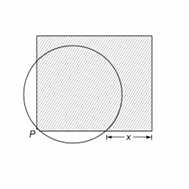
Q.28 The proportion of the sheet area that remains after punching is:
(a) \( \frac{\pi + 2}{8} \)
(b) \( \frac{6 – \pi}{8} \)
(c) \( \frac{4 – \pi}{4} \)
(d) \( \frac{\pi – 2}{4} \)
(e) \( \frac{14 – 3\pi}{6} \)
Q.29 Find the area of the part of the circle (round punch) falling outside the square sheet.
(a) \( \frac{\pi}{4} \)
(b) \( \frac{\pi – 1}{2} \)
(c) \( \frac{\pi – 1}{4} \)
(d) \( \frac{\pi – 2}{2} \)
(e) \( \frac{\pi – 2}{4} \)
Q.30 A semicircle is drawn with AB as its diameter. From C, a point on AB, a line perpendicular to AB meets the semicircle at D. Given AC = 2 cm and CD = 6 cm, the area (in sq cm) of the semicircle is:
(a) \( 32\pi \)
(b) 50
(c) \( 40.5\pi \)
(d) \( 81\pi \)
(e) Undeterminable
Q.31 A jogging park has two identical circular tracks touching each other and a rectangular track enclosing them. A runs along the rectangle and B runs along the circular tracks (figure of eight). Approximately, how much faster than A must B run so both take same time?
(a) 3.88%
(b) 4.22%
(c) 4.44%
(d) 4.72%
Q.32 Two identical circles intersect such that their centres and intersection points form a square of side 1 cm. Find the common area (in sq cm).
(a) \( \frac{\pi}{4} \)
(b) \( \frac{\pi}{2} – 1 \)
(c) \( \frac{\pi}{5} \)
(d) \( \sqrt{2} – 1 \)
Q.33 Rectangular tiles each of size 70 cm x 30 cm must be laid horizontally on a rectangular floor of size 110 cm x 130 cm, such that the tiles do not overlap. A tile can be placed in any orientation so long as its edges are parallel to the edges of the floor. No tile should overshoot any edge of the floor. The maximum number of tiles that can be accommodated on the floor is
(a) 4
(b) 5
(c) 6
(d) 7
Q.34 P, Q, S and R are points on the circumference of a circle of radius r, such that PQR is an equilateral triangle and PS is a diameter of the circle. What is the perimeter of the quadrilateral PQSR?
(a) 2r(1 + √3)
(b) 2r(2 + √3)
(c) r(1 + √5)
(d) 2r + √3
Q.35 A rectangular sheet of paper, when halved by folding it at the mid-point of its longer side, results in a rectangle, whose longer and shorter sides are in the same proportion as the longer and shorter sides of the original rectangle. If the shorter side of the original rectangle is 2, what is the area of the smaller rectangle?
(a) 4√2
(b) 2√2
(c) √2
(d) None of these
Q.36 A piece of paper is in the shape of a right angled triangle and is cut along a line that is parallel to the hypotenuse, leaving a smaller triangle. There was a 35% reduction in the length of the hypotenuse of the triangle. If the area of the original triangle was 34 square inches before the cut, what is the area (in square inches) of the smaller triangle?
(a) 16.665
(b) 16.565
(c) 15.465
(d) 14.365
Q.37 A square tin sheet of side 12 inches is converted into a box with open top in the following steps. The sheet is placed horizontally. Then, equal sized squares, each of side x inches, are cut from the four corners of the sheet. Finally, the four resulting sides are bent vertically upwards in the shape of a box. If x is an integer, then what value of x maximizes the volume of the box?
(a) 3
(b) 4
(c) 1
(d) 2
Q.38 The length of the circumference of a circle equals the perimeter of a triangle of equal sides and also the perimeter of a square. The areas covered by the circle, triangle and square are c, t and s, respectively. Then,
(a) s > t > c
(b) c < s > t
(c) c > s > t
(d) s > c > t
Q.39 Neeraj has agreed to mow the farm lawn, which is a 20 m by 40 m rectangle. The mower moves a 1 m wide strip. If Neeraj starts at one corner and moves around the lawn towards the centre, about how many times would he go round before he has mowed half the lawn?
(a) 2.5
(b) 3.5
(c) 3.8
(d) 4.0
Q.40 Four horses are tethered at four corners of a square plot of side 14 m, so that adjacent horses can just reach one another. There is a small circular pond of area 20 m² at the centre. Find the ungrazed area.
(a) 22 m²
(b) 42 m²
(c) 84 m²
(d) 168 m²
Q.41 Instead of walking along two adjacent sides of a rectangular field, a boy took a short cut along the diagonal and saved a distance equal to half the long side. Then, the ratio of the shorter side to the long side is
(a) 1/2
(b) 2/3
(c) 1/4
(d) 3/4
Q.42 A piece of string is 40 cm long. It is cut into three pieces. The longest piece is 3 times as long as the middle-sized and the shortest piece is 23 cm shorter than the longest piece. Find the length of the shortest piece (in cm).
(a) 27
(b) 5
(c) 4
(d) 9
Q.43 A rectangular pool 20 m wide and 60 m long is surrounded by a walkway of uniform width. If the total area of the walkway is 516 sq m, how wide (in m) is the walkway?
(a) 43
(b) 4.3
(c) 3
(d) 3.5
Q.44 Based on the figure, find \( x \) if y = 10.
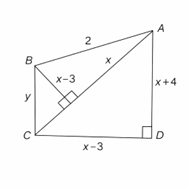
(a) 10
(b) 11
(c) 12
(d) None of these
Q.45 Euclid had a triangle in mind. Its longest side has length 20 and another side has length 10. Its area is 80. What is the exact length of its third side?
(a) \( \sqrt{260} \)
(b) \( \sqrt{250} \)
(c) \( \sqrt{240} \)
(d) \( \sqrt{270} \)
Q.46 Two sides of a plot measure 32 m and 24 m and the angle between them is a right angle. The other two sides measure 25 m each and the remaining angles are not right angles. What is the area of the plot (in m²)?
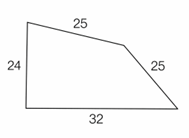
(a) 768
(b) 534
(c) 696.5
(d) 684
Q.47 A certain city has a circular wall with four gates (North, South, East, West). A house is 3 km North of the North gate and is just visible from a point 9 km East of the South gate. Find the diameter of the wall.
(a) 6 km
(b) 9 km
(c) 12 km
(d) None of these
Q.48 A square of side 2 m has its corners cut to form an octagon with equal sides. Find the length of each side.
(a) \( \frac{\sqrt{2}}{\sqrt{2} + 1} \)
(b) \( \frac{2}{\sqrt{2} + 1} \)
(c) \( \frac{2}{\sqrt{2} – 1} \)
(d) \( \frac{\sqrt{2}}{\sqrt{2} – 1} \)
Q.49 What is the number of distinct triangles with integral sides and perimeter 14?
(a) 6
(b) 5
(c) 4
(d) 3
Q.50 Consider a circle with unit radius. There are seven adjacent sectors \( S_1, S_2, \dots, S_7 \) whose total area is \( \frac{1}{8} \) of the circle. Each sector has twice the area of the previous one. Find the angle (in radians) of \( S_1 \).
(a) \( \frac{\pi}{508} \)
(b) \( \frac{\pi}{2040} \)
(c) \( \frac{\pi}{1016} \)
(d) \( \frac{\pi}{1524} \)
Q.51 Two concentric circles with centre O are given. PQRS is a square inscribed in the outer circle and circumscribes the inner circle. Find the ratio of the perimeter of the outer circle to that of polygon ABCD.
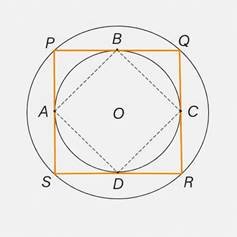
(a) \( \frac{\pi}{4} \)
(b) \( \frac{3\pi}{2} \)
(c) \( \frac{\pi}{2} \)
(d) \( \pi \)